What Is Affiliate Marketing? Complete Guide for Beginners
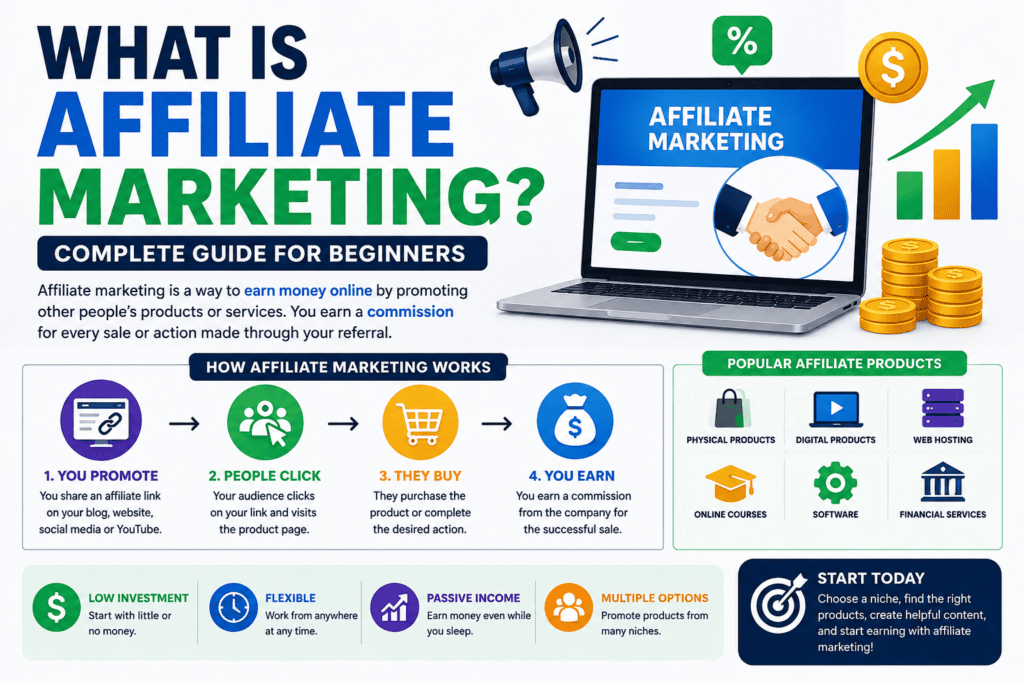
If you have ever wondered what is affiliate marketing, you are not alone. Affiliate marketing has become a popular way for bloggers, content creators, YouTubers, and website owners to monetize their online audience.
In simple terms, affiliate marketing allows you to recommend products or services from other companies. When someone makes a qualifying purchase or completes a required action through your unique affiliate link, you may earn a commission.
However, successful affiliate marketing is about more than adding links to a website. Instead, you need to understand your audience, choose useful products, create helpful content, and build trust.
In this guide, you will learn how affiliate marketing works, how beginners can get started, how commissions work, and practical affiliate marketing tips that can help you build a sustainable strategy.
How Does Affiliate Marketing Work?
The process is relatively simple. However, each affiliate program can have different rules and requirements.
1. Choose a Niche
First, choose a topic that you understand or are willing to learn about.
Popular affiliate marketing niches include:
Technology
Digital marketing
Education
Travel
Beauty
Fitness
Photography
Software
Personal finance
A focused niche makes it easier to understand your audience. Moreover, it helps you find products that naturally fit your content.
2. Find an Affiliate Program
Next, look for affiliate programs related to your niche.
Some companies operate their own affiliate programs, while others use affiliate networks to manage tracking, commissions, and payments.
Before joining a program, check:
Commission rates
Payment schedule
Cookie duration
Minimum payout
Program rules
Promotional restrictions
Product quality
Eligibility requirements
Most importantly, do not choose a program only because it offers a high commission.
3. Get Your Affiliate Link
After joining and getting approved, the program usually provides a unique affiliate link.
The link contains tracking information that helps the merchant identify referrals from your content.
For example:
example.com/product
may become something similar to:
example.com/product/?affiliate=123
The exact format depends on the affiliate program.
4. Create Useful Content
After getting your affiliate link, create content that helps people make informed decisions.
You can publish:
Product reviews
Comparison articles
Buying guides
Tutorials
YouTube videos
Social media content
Email newsletters
Product roundups
Instead of simply telling people to buy something, explain how the product works, who it is suitable for, and what its advantages and limitations are.
As a result, your content becomes more valuable to your audience.
5. A Visitor Clicks Your Link
When someone discovers your content and clicks your affiliate link, the affiliate system records the referral.
The tracking process can vary between programs. Therefore, always read the specific program’s terms.
6. The Visitor Completes an Action
Finally, the visitor completes the action required by the program.
This might be:
Purchasing a product
Signing up for a service
Registering for an account
Submitting a lead
Starting a free trial
If the action meets the program requirements, you may receive a commission.
How to Start Affiliate Marketing as a Beginner
Starting affiliate marketing does not have to be complicated. Instead, you can build your strategy step by step.
Choose a Specific Niche
Start with a focused topic instead of trying to promote everything.
For example, rather than creating a general technology website, you could focus on budget smartphones, SEO tools, website hosting, or software for small businesses.
A focused niche can make your content more relevant and easier to organize.
Understand Your Audience
Next, research what your audience needs.
Ask questions such as:
What problems are they trying to solve?
What products are they researching?
What questions do they ask?
What features matter to them?
What information do they need before buying?
Then, create content that answers those questions.
Find Relevant Products
Once you understand your audience, look for products that genuinely solve their problems.
For instance, if your audience wants to learn SEO, you might review SEO tools, courses, website tools, or other relevant resources.
However, only recommend products that are appropriate for your audience.
Create Helpful Content
Content is one of the most important parts of affiliate marketing.
You can create articles such as:
Best [Product] for Beginners
[Product A] vs [Product B]
How to Use [Product]
[Product] Review
Pros and Cons of [Product]
Best Tools for [Specific Audience]
Additionally, answer common questions that users search for on Google.
Add Affiliate Links Naturally
Affiliate links should support your content rather than interrupt it.
For example, after explaining the features of a product, you can provide a relevant link where readers can learn more.
Avoid adding affiliate links to every paragraph. Instead, use them where they provide a useful next step.
Promote Your Content
Creating content is only the beginning.
You also need to attract relevant visitors through channels such as:
SEO
Google Search
YouTube
Social media
Email marketing
Content marketing
Furthermore, SEO can be especially useful because people often search for reviews and comparisons before purchasing products.
Types of Affiliate Marketing
Affiliate programs can use different commission models.
Pay Per Sale
With pay-per-sale affiliate marketing, you earn a commission when someone makes a qualifying purchase through your referral.
This is one of the most common affiliate models.
Pay Per Lead
With pay-per-lead programs, you can earn when a referred visitor completes a required lead action.
For example, the visitor might submit a form, request information, or register for a service.
Pay Per Action
Pay-per-action programs reward affiliates when visitors complete a specific action.
The required action depends on the individual program.
Therefore, always check the program terms before promoting an offer.
Affiliate Marketing Examples
Understanding examples can make affiliate marketing easier to understand.
Technology Blog Example
Suppose you run a technology website.
You publish an article called “Best Budget Laptops for Students.”
You compare several laptops, explain their features, discuss their advantages and limitations, and provide relevant affiliate links.
If a reader clicks one of your links and completes a qualifying purchase, you may earn a commission.
YouTube Example
Imagine that you have a YouTube channel about smartphones.
You publish a detailed smartphone review covering the camera, display, battery, performance, and features.
Then, you include an affiliate link where viewers can learn more about the phone.
If a viewer completes a qualifying purchase through the link, you may earn a commission.
Educational Website Example
An educational website could recommend online courses, books, software, and learning tools.
For example, an article about learning graphic design could compare several online courses.
Consequently, readers receive useful information while the website has an opportunity to earn from qualifying referrals.
Affiliate Marketing Tips for Beginners
If you want to build a successful affiliate strategy, keep your audience at the center of your content.
1. Focus on Your Audience
Your audience should come before commissions.
Therefore, recommend products that can genuinely help them.
2. Write Honest Reviews
Do not describe every product as perfect.
Instead, discuss both benefits and limitations. This approach can make your content more trustworthy.
3. Match Products With Search Intent
Consider what the user actually wants.
Someone searching for “best laptop for students” may be researching products before making a purchase.
On the other hand, someone searching for “how to clean a laptop” probably needs educational information rather than a sales recommendation.
Understanding search intent can help you create more relevant content.
4. Avoid False Income Claims
Affiliate marketing does not guarantee a specific income.
Therefore, avoid promises such as “earn ₹1 lakh every month guaranteed.”
Instead, explain that results depend on traffic, niche, content quality, conversion rates, commissions, and audience trust.
5. Keep Your Content Updated
Products, prices, features, and affiliate programs can change.
For this reason, review your older content regularly and update outdated information.
6. Learn SEO
SEO can help your affiliate content reach people who are actively searching for information.
Learn the basics of:
Keyword research
Search intent
On-page SEO
Internal linking
Meta descriptions
Content structure
Technical SEO
Most importantly, create content for people rather than simply writing for search engines.
Benefits of Affiliate Marketing
Affiliate marketing can provide several benefits when used correctly.
You Do Not Need Your Own Product
You can promote products created by other companies.
Therefore, you do not need to manufacture, store, or ship physical products yourself.
You Can Promote Multiple Products
Depending on program rules, you can recommend different products within your niche.
This allows you to create reviews, comparisons, tutorials, and buying guides.
It Offers Flexible Content Options
You can use blogs, YouTube videos, social media, email newsletters, and other permitted platforms.
As a result, you can choose content formats that suit your skills and audience.
It Can Complement SEO
Helpful product reviews and comparison articles can attract people who are already researching potential purchases.
Consequently, affiliate marketing can work alongside an SEO strategy.
It Can Support Other Marketing Channels
Affiliate marketing can be combined with:
SEO
Content marketing
Email marketing
YouTube
Social media marketing
Therefore, it can become part of a broader digital marketing strategy.
Common Affiliate Marketing Mistakes
Beginners often make mistakes when they focus too much on commissions.
Promoting Irrelevant Products
A product with a high commission is not necessarily a good product for your audience.
Instead, focus on relevance and value.
Creating Thin Content
An article filled with affiliate links but lacking useful information is unlikely to provide a good experience.
Therefore, include original explanations, comparisons, examples, and practical advice.
Using Too Many Affiliate Links
More links do not automatically mean more earnings.
Instead, place links naturally where they help readers.
Copying Product Descriptions
Do not simply copy descriptions from manufacturers or competitors.
Rather, add your own analysis, comparisons, examples, and insights.
Expecting Instant Results
Affiliate marketing usually takes time.
First, you need to create content. Then, you need to attract visitors, build trust, generate clicks, and improve conversions.
Therefore, consistency is important.
How Much Money Can You Make With Affiliate Marketing?
There is no fixed amount that every affiliate can earn.
Some beginners may earn very little at first. Meanwhile, established websites and creators may generate significant revenue.
A simple way to understand potential affiliate revenue is:
Traffic × Click-Through Rate × Conversion Rate × Commission = Potential Revenue
For example, a website can have thousands of visitors but still earn little if those visitors are not interested in the recommended products.
Therefore, relevant traffic is often more valuable than simply having a large number of visitors.
Your results may depend on:
Niche
Audience
Traffic
Product demand
Commission rate
Conversion rate
Content quality
Competition
Is Affiliate Marketing Free to Start?
Affiliate marketing can have relatively low startup costs.
For example, some beginners can start by creating content on platforms they already use. However, building a professional website can involve expenses such as:
Domain
Hosting
Website tools
Design
Content creation
Marketing
Additionally, you need to invest time in research, content creation, promotion, and learning.
Therefore, low startup costs do not mean affiliate marketing requires no effort.
Is Affiliate Marketing Worth It for Beginners?
Affiliate marketing can be worth exploring if you enjoy creating content, reviewing products, educating people, or building an online audience.
It may be especially suitable for people interested in:
Blogging
YouTube
SEO
Content creation
Digital marketing
Product reviews
Online business
However, there is no guaranteed income.
Your results can depend on your niche, audience, content quality, traffic, product selection, competition, and conversion rate.
For that reason, beginners should treat affiliate marketing as a long-term strategy rather than a quick-money opportunity.
Frequently Asked Questions About Affiliate Marketing
What Is Affiliate Marketing in Simple Words?
Affiliate marketing means promoting another company’s product or service and potentially earning a commission when someone completes a qualifying action through your unique affiliate link.
How Does Affiliate Marketing Work?
An affiliate joins a program, receives a unique tracking link, creates useful promotional content, attracts visitors, and earns a commission when a qualifying action occurs.
Can Beginners Start Affiliate Marketing?
Yes. Beginners can start by choosing a niche, understanding their audience, finding relevant affiliate programs, and creating useful content.
Do I Need a Website for Affiliate Marketing?
Not necessarily. Depending on the program rules, you may use a website, YouTube channel, social media platform, email newsletter, or another permitted channel.
Is Affiliate Marketing Passive Income?
Affiliate content can continue generating traffic after publication. Nevertheless, successful websites usually require regular updates, new content, promotion, and optimization.
How Do I Choose Affiliate Products?
Choose products that are relevant, useful, trustworthy, and appropriate for your audience.
Most importantly, do not choose products based only on commission rates.
Can Affiliate Marketing Make You Rich?
Affiliate marketing can generate income, but there is no guaranteed amount.
Your results depend on factors such as traffic, niche, product demand, conversion rate, commission structure, and content quality.
Final Thoughts
Affiliate marketing is more than placing referral links inside blog posts or social media content.
Instead, it is about connecting the right audience with products and services that can genuinely help them.
First, choose a focused niche. Next, understand your audience and research suitable affiliate programs. Then, create helpful content, add relevant links naturally, and measure your results.
Meanwhile, continue improving your SEO, content quality, and audience experience.
Most importantly, focus on providing value rather than chasing commissions.
When your content genuinely helps people make better decisions, affiliate marketing can become a useful part of a broader digital marketing strategy.
Start Learning Digital Marketing With Vidya Sharthi
Want to build practical skills in SEO, affiliate marketing, digital marketing, content writing, social media marketing, and Google Ads?
Vidya Sharthi can help beginners understand important digital marketing concepts and develop practical knowledge for the online world.
Start learning practical digital marketing skills and build your digital future today!
Type your paragraph here