Introduction
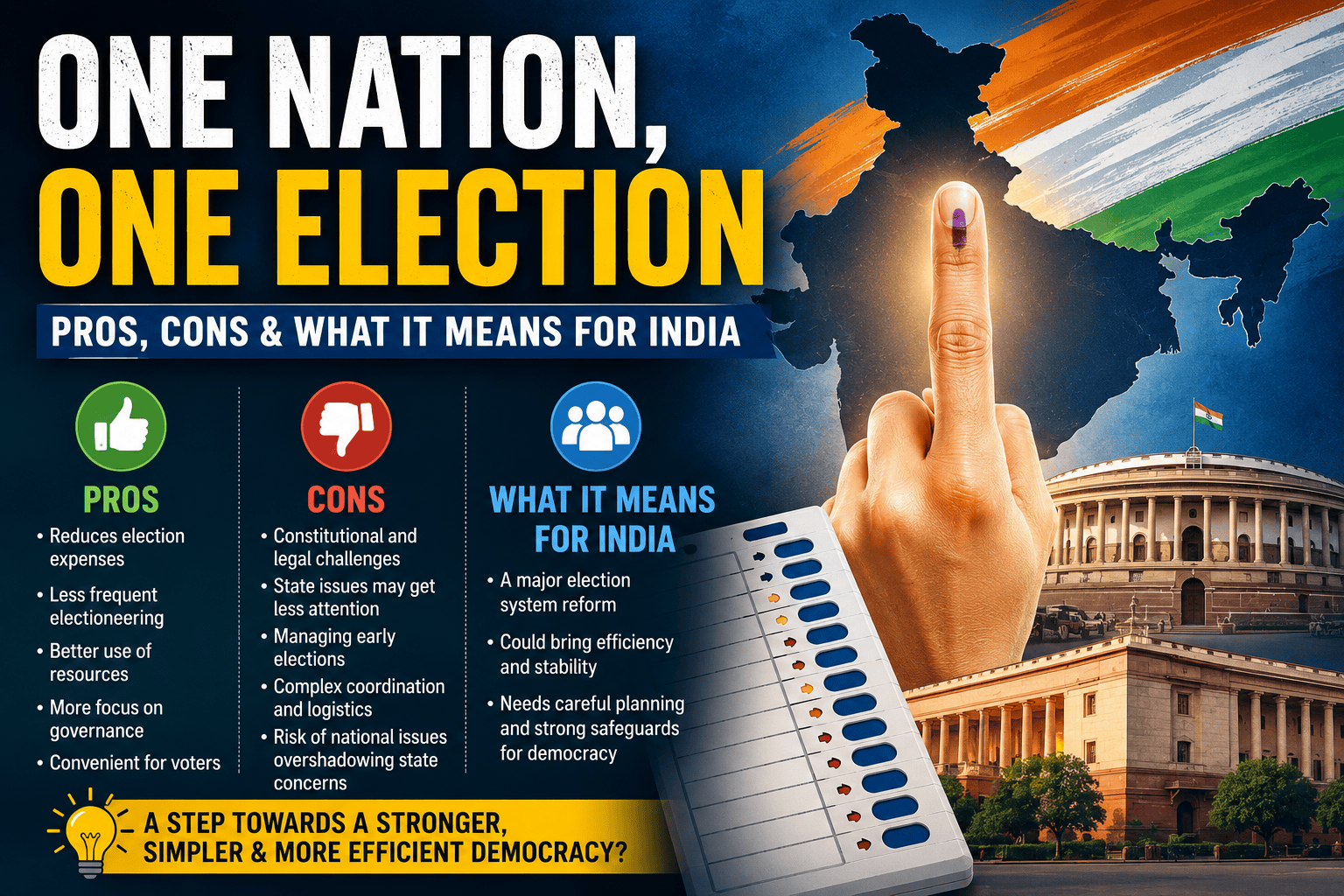
Imagine a situation where Lok Sabha and state assembly elections are held together across India. Instead of elections happening at different times, voters could potentially vote for both levels of government around the same period.
This idea is known as One Nation, One Election. It has attracted considerable attention because it could change the way elections are planned and conducted in India.
But what exactly does it mean? What are the One Nation One Election benefits, and what challenges could come with it?
In this blog, we will understand the idea in simple language and look at its major pros, cons, and possible impact on India.
What is One Nation, One Election?
One Nation, One Election refers to the proposal of holding elections to the Lok Sabha and state legislative assemblies simultaneously.
At present, elections take place at different times because the terms of different governments can end at different points. Under simultaneous elections, the goal would be to bring these election cycles together.
The main idea is to reduce the frequency of elections and create a more coordinated election system.
However, implementing such a system would require changes to election arrangements, laws, and the way election cycles are managed.
Why Is One Nation, One Election Being Discussed?
India is a large democracy, and elections require significant planning and resources.
Frequent elections can involve:
- Large numbers of polling personnel
- Security arrangements
- Election campaigning
- Administrative resources
- Government machinery
- Significant public expenditure
Supporters believe that conducting elections together could reduce some of these repeated requirements.
At the same time, critics raise questions about whether simultaneous elections could affect regional issues, political competition, and the federal structure of India.
Therefore, the discussion is not simply about saving money. It is also about how elections should work in a diverse democracy.
One Nation One Election Benefits
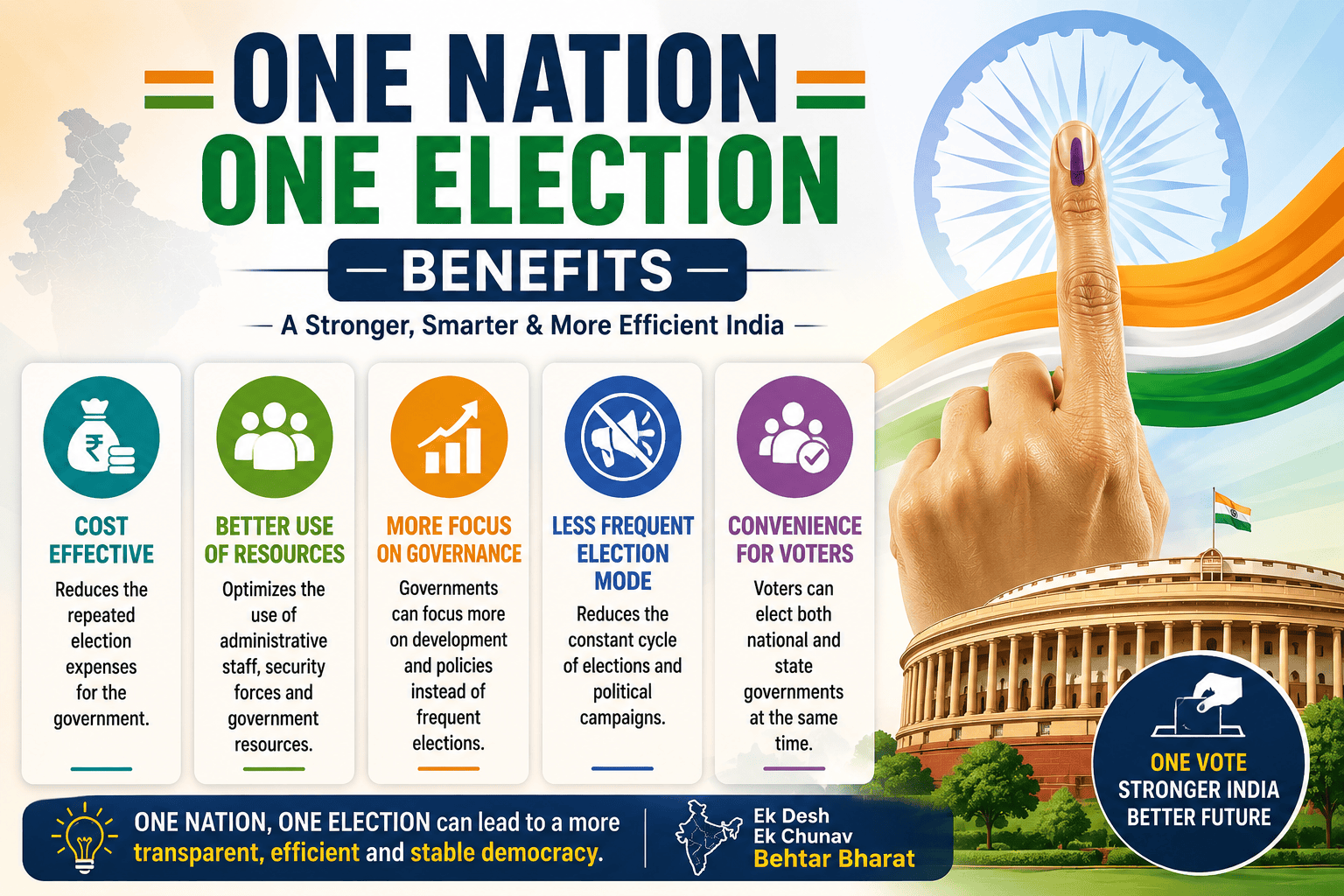
There are several possible One Nation One Election benefits that supporters highlight.
1. Reduced Election Expenses
Holding elections at different times requires repeated spending on campaigning, security, transportation, polling arrangements, and administration.
If elections are conducted together, some of these expenses could potentially be reduced.
This could make the overall election process more efficient.
2. Less Frequent Election Campaigning
India regularly goes through election campaigns at different levels.
With simultaneous elections, the country could potentially experience fewer separate election periods. This may reduce the continuous cycle of campaigning and allow political parties and governments to focus more on governance between elections.
3. Better Use of Government Resources
Election duties require government employees, teachers, security personnel, and other staff to participate in the process.
If elections are held together, these resources may need to be deployed less frequently.
Therefore, supporters argue that administrative resources could be used more efficiently.
4. More Focus on Governance
Frequent elections can influence political decision-making because governments and political parties may have to prepare for upcoming elections.
With a more synchronized election cycle, governments could potentially get longer periods to concentrate on policies and development work without constantly preparing for another election.
5. Convenience for Voters
Another possible benefit is convenience.
Instead of repeatedly participating in elections at different times, voters could potentially vote for the Lok Sabha and state assembly within the same election period.
However, voter convenience would depend on how the system is ultimately designed and implemented.
What Are the Challenges of One Nation, One Election?
While the idea has potential benefits, One Nation, One Election also raises important concerns.
1. Constitutional and Legal Challenges
The terms of the Lok Sabha and state assemblies do not always end at the same time.
Synchronizing them would therefore require significant legal and constitutional arrangements.
The system would need clear rules for situations where a government loses its majority before completing its term.
2. Impact on Regional Issues
India has many states with different political, economic, cultural, and social priorities.
During simultaneous elections, there is a concern that national issues could receive greater attention than state-level issues.
For example, voters may focus heavily on national leadership while giving less attention to local policies and state government performance.
3. Difficulty in Managing Early Elections
What happens if a state government falls before its scheduled election?
This is one of the important questions surrounding simultaneous elections.
A practical system would need to decide whether a new election should be held immediately, whether the new government would have a shorter term, or whether another arrangement should be used.
4. Large-Scale Election Management
Conducting elections across India at the same time would require enormous logistical planning.
Polling stations, electronic voting machines, security personnel, election officials, transportation, and other resources would need to be available on a very large scale.
Therefore, implementation would be a major administrative task.
5. Risk of Oversimplifying Voter Choices
Lok Sabha and state elections involve different responsibilities.
A voter may prefer one political party at the national level and another at the state level.
If elections happen together, there could be concerns about voters treating both elections similarly because of a strong national political campaign.
This could potentially influence the balance between national and regional politics.
How Could One Nation, One Election Change Elections in India?
If implemented, One Nation, One Election could change India’s election calendar significantly.
Political parties may need to prepare for national and state elections together. Election campaigns could become more centralized, while voters would have to evaluate candidates and parties at two different levels during the same election period.
It could also change how governments plan their work.
Instead of facing frequent elections, governments may have longer uninterrupted periods to focus on policies and development.
However, the success of such a system would depend on careful planning, strong election management, and safeguards for India’s federal structure.
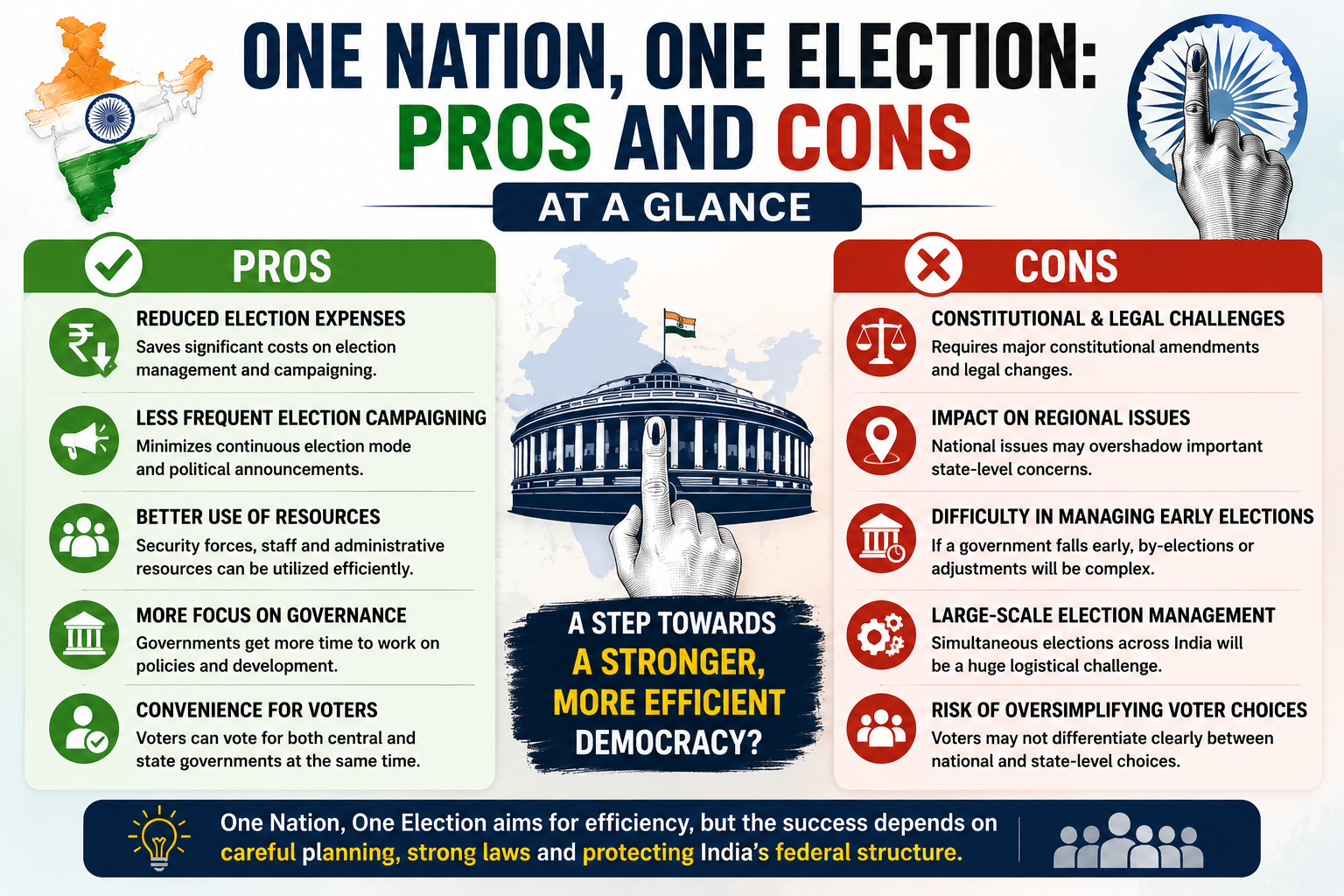
One Nation, One Election: Pros and Cons at a Glance
| Pros | Cons |
|---|---|
| Could reduce repeated election expenses | Major constitutional and legal changes may be needed |
| May reduce frequent election campaigns | Regional issues could receive less attention |
| Better use of administrative resources | Managing simultaneous elections would be complex |
| May provide greater policy continuity | Early government collapse creates difficult questions |
| Could be convenient for voters | National issues may influence state-level voting |
What Does It Mean for Indian Voters?
For voters, the biggest change could be the timing and experience of elections.
Citizens may have to make decisions about both national and state governments around the same time. This could make voting more convenient, but it could also require voters to clearly understand the different responsibilities of the two levels of government.
Therefore, voter awareness would become especially important.
Voters would need to ask two different questions:
Who should govern the country?
And:
Who should govern my state?
Understanding this difference can help citizens make informed choices regardless of how elections are scheduled.
Conclusion
One Nation, One Election is a major proposed change to India’s election system. Its supporters point to possible benefits such as reduced election expenses, better use of resources, fewer election campaigns, and greater focus on governance.
However, the idea also presents serious challenges involving constitutional arrangements, election management, regional representation, and the possibility of governments falling before their full terms.
Therefore, the debate is not simply about having elections on the same day. It is about finding a system that balances efficiency, voter choice, federalism, and democratic representation.
Whether One Nation, One Election becomes a reality will depend on how these challenges are addressed and how the system is designed.
What Do You Think?
Would One Nation, One Election make India’s election system more efficient, or could it create new challenges for democracy?
Share your opinion in the comments!
If you found this blog useful, share it with others and explore more easy-to-understand articles on Indian elections, politics, and current affairs.