
Introduction
Keyword research is one of the most important parts of SEO. If we want our website or blog to appear on Google, we need to understand what people are searching for online. This is where keyword research helps us.
When people want to learn something, buy a product, find a service, or solve a problem, they usually search for it on Google. They type words or phrases such as “best digital marketing course,” “SEO course for beginners,” “online computer courses,” or “how to learn digital marketing.” These words and phrases are called keywords.
Keyword research is the process of finding these keywords and understanding how people use them in search engines.
For example, if we are running a digital education institute, our students may search for terms like “digital marketing course,” “SEO course,” “online courses,” “best computer course,” or “digital marketing training.” By knowing these keywords, we can create useful content that answers their questions.
In simple words, keyword research helps us understand what people are searching for so that we can create the right content for the right audience.
Keyword research is not only about finding popular keywords. We also need to understand the search intent, competition, relevance, and type of audience behind each keyword.
Summary
Keyword research is the process of finding and analyzing words and phrases that people search for on Google and other search engines.
It helps us understand our audience and create content based on their needs. It also helps us choose better blog topics and improve our chances of getting traffic from search engines.
There are different types of keywords, such as short-tail keywords, long-tail keywords, informational keywords, and commercial keywords.
For example, “SEO” is a short keyword, while “SEO course for beginners” is a more specific long-tail keyword.
Good keyword research helps us:
Understand what our audience is searching for
Find useful topics for our blogs
Improve our SEO
Reach the right audience
Increase website traffic
Generate more business opportunities
The main goal is not to add keywords everywhere. The goal is to understand our audience and create useful content that answers their questions.
Main Content
What Is Keyword Research in SEO?


Keyword research in SEO means finding the words and phrases that people use when they search on Google.
Let’s understand this with a simple example.
Suppose a student wants to learn digital marketing. The student may search on Google:
What is digital marketing?
Digital marketing course
Best digital marketing course
Digital marketing course for beginners
Digital marketing classes near me
How to learn digital marketing?
These search terms are keywords.
If we have a digital education institute, we can create blogs and website pages around these keywords. This can help us reach students who are already looking for digital marketing education.
So, keyword research connects what people are searching for with the content we create.
Why Is Keyword Research Important?
Keyword research is important because it helps us create content that people actually want to read.
Without keyword research, we may write many blogs but may not get enough visitors. We may choose topics that sound interesting to us but are not being searched by our target audience.
Keyword research helps us make better decisions.
1. It Helps Us Understand Our Audience
Keywords tell us what people want to know.
For example, if many people are searching for “SEO course for beginners,” it shows that beginners are interested in learning SEO.
We can then create a simple blog explaining SEO, its benefits, career opportunities, and how beginners can start learning it.
2. It Helps Us Find Better Blog Topics
Sometimes it is difficult to decide what we should write about.
Keyword research gives us different topic ideas.
For example, if our main keyword is “digital marketing course,” we can create topics such as:
What is a digital marketing course?
Benefits of learning digital marketing
Digital marketing skills for beginners
How to start a career in digital marketing
Best digital marketing skills to learn
This makes content planning easier.
3. It Helps Improve SEO
SEO stands for Search Engine Optimization. It is the process of improving our website and content so that search engines can understand and rank it better.
When we use relevant keywords naturally in our content, Google can understand what our page is about.
We can use keywords in places such as the blog title, headings, introduction, body content, URL, image alt text, and meta description.
However, we should not use the same keyword again and again just to rank on Google. The content should feel natural and useful to the reader.
Types of Keywords
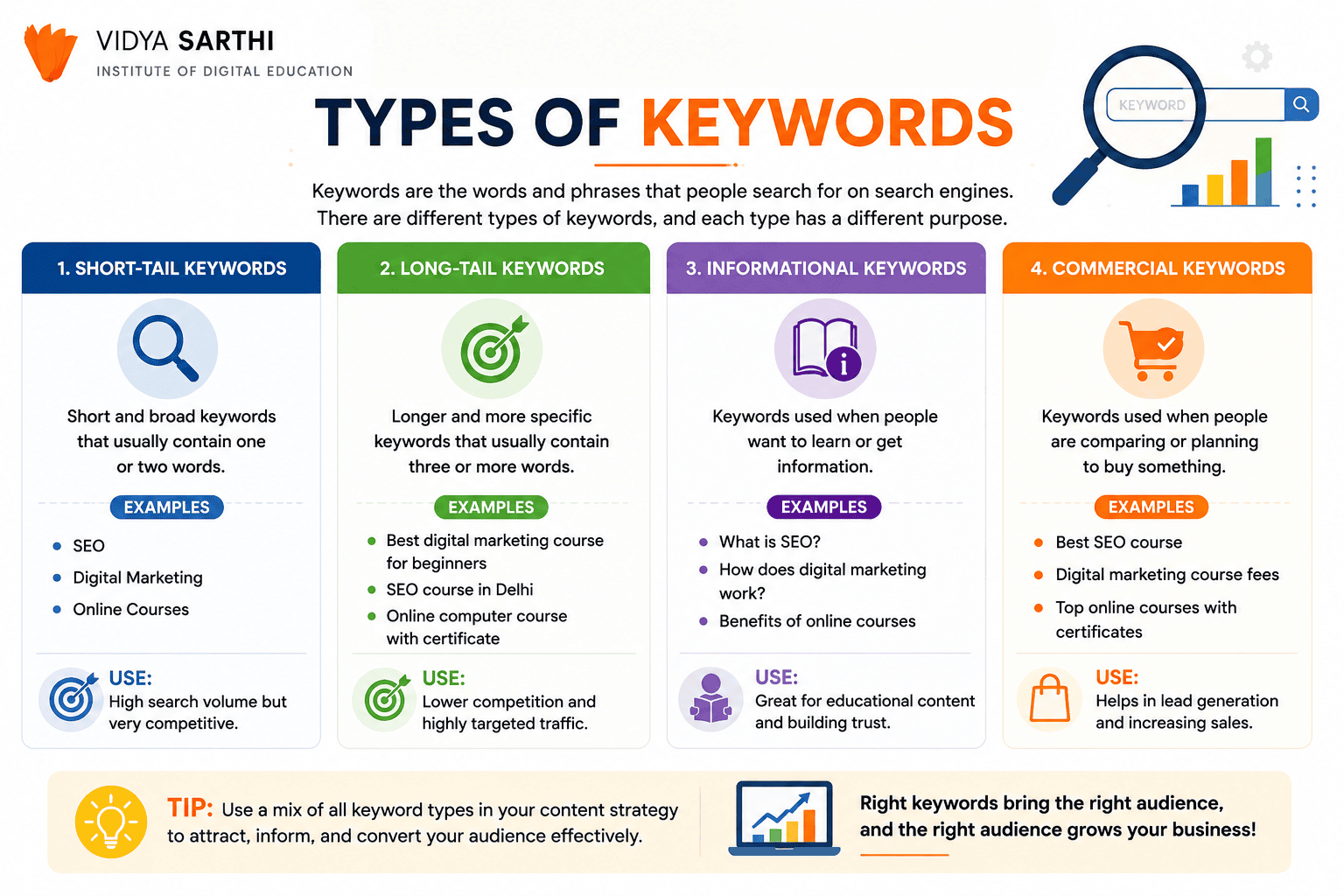
There are different types of keywords that we can use in SEO.
Short-Tail Keywords
Short-tail keywords are usually short and broad.
Examples include:
SEO
Digital marketing
Online courses
Computer courses
These keywords may have a large number of searches, but they can also have high competition.
Long-Tail Keywords
Long-tail keywords are longer and more specific.
Examples include:
Best digital marketing course for beginners
SEO course for beginners
Digital marketing course with certification
Best online computer course for students
Long-tail keywords can help us target a more specific audience.
For example, someone searching for “SEO” may only want information about SEO. But someone searching for “SEO course for beginners” may be looking for a course to learn SEO.
Understanding Search Intent
Search intent means understanding why a person is searching for a particular keyword.
This is very important in keyword research.
For example, someone searching for “what is SEO” probably wants information. They are trying to learn something.
Someone searching for “best SEO course” may be comparing different courses.
Someone searching for “SEO course fees” may already be interested in joining a course and wants to know the price.
So, we should create content according to the user’s search intent.
If people want information, we should provide information. If they want to compare options, we should provide useful comparisons. If they are ready to join a course, we should make it easy for them to learn more and take the next step.
How to Do Keyword Research?
Keyword research can be done using different SEO tools and Google search itself.
First, we should understand our business and target audience.
For a digital education institute, we can think about what students may want to learn. For example, they may be interested in digital marketing, SEO, web development, computer courses, or other career-related skills.
Next, we can create a list of basic keywords.
For example:
Digital marketing course 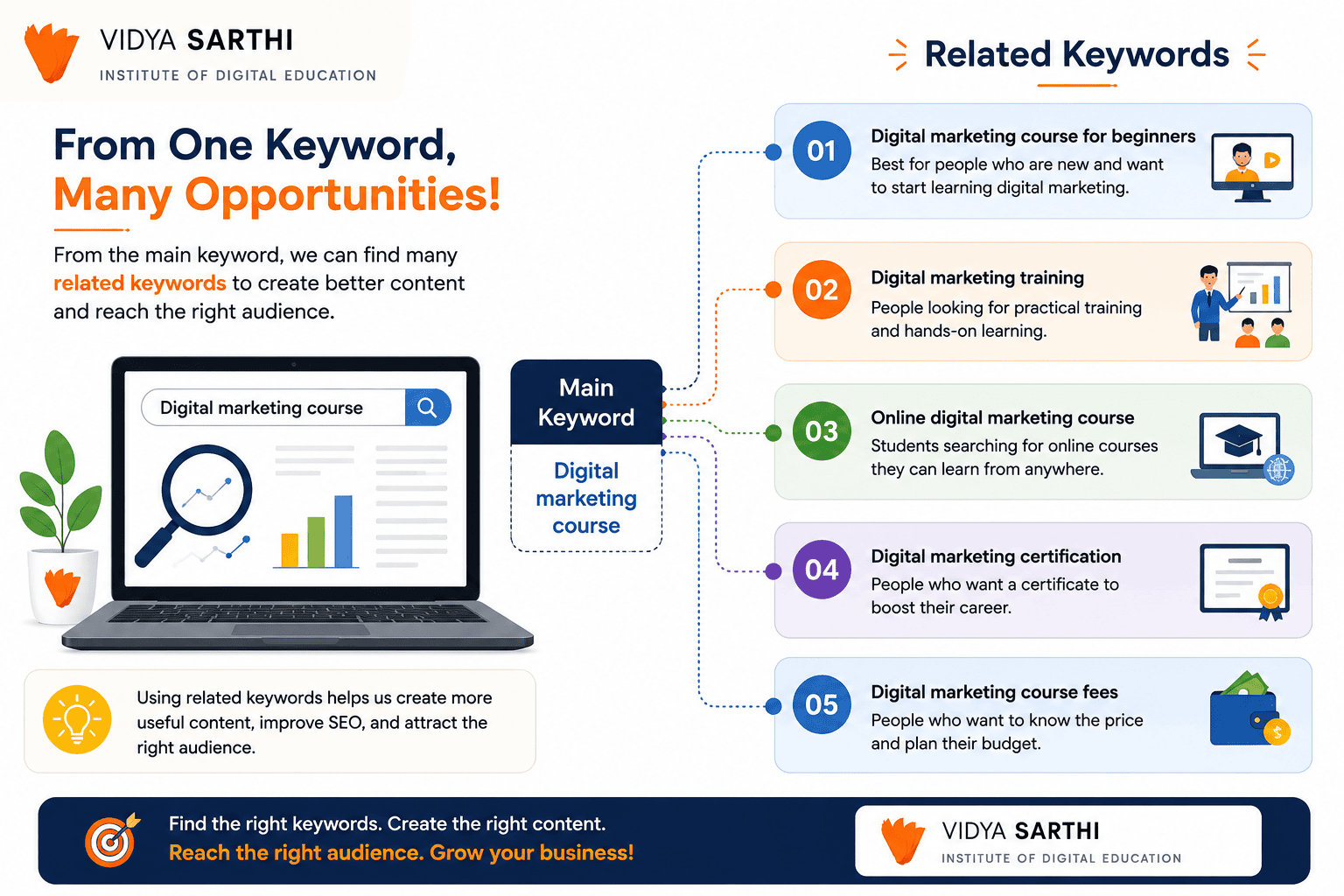
From this keyword, we can find related keywords such as:
Digital marketing course for beginners
Digital marketing training
Online digital marketing course
Digital marketing certification
Digital marketing course fees
After creating a keyword list, we should check the search volume and competition.
Search volume tells us approximately how many people are searching for a keyword. Competition tells us how difficult it may be to rank for that keyword.
We should not always choose the keyword with the highest search volume. A more specific keyword with lower competition can sometimes be more useful.
Common Keyword Research Mistakes
There are some common mistakes that we should avoid.
The first mistake is keyword stuffing. This means using the same keyword too many times in the content. It can make the blog difficult to read and may not provide a good experience for users.
The second mistake is choosing keywords that are not related to our business. A keyword may have high search volume, but if it is not relevant to our audience, it may not bring useful traffic.
The third mistake is ignoring long-tail keywords. Specific keywords can help us reach people who have a clear interest or need.
Another mistake is writing only for search engines. We should always remember that real people are going to read our content.
Our content should be simple, useful, and easy to understand.
How Keyword Research Helps a Digital Education Institute
Keyword research can be very useful for a digital education institute like Vidya Sharthi.
Students are searching online for courses, skills, career options, certifications, and learning resources.
By understanding these searches, an education institute can create blogs that answer common student questions.
For example, Vidya Sharthi can create content around topics like:
What is digital marketing?
What are the benefits of learning SEO?
How to start a career in digital marketing?
What skills are needed for digital marketing?
Why should students learn digital marketing?
What is SEO and how does it work?
These blogs can provide useful information to students while also helping the institute reach people who are searching for these topics online.
Conclusion
Keyword research is an important part of SEO because it helps us understand what people are searching for.
It allows us to choose the right topics, create useful content, improve our website visibility, and reach the right audience.
Good keyword research is not about adding as many keywords as possible. It is about finding relevant keywords and understanding the needs behind those searches.
For a digital education institute, keyword research can help connect students with the right learning information. By creating useful and simple content around relevant keywords, we can build trust with our audience and make it easier for students to find the courses and skills they are looking for.
In simple words, keyword research helps us understand our audience, create better content, and reach the right people through search engines.
Call to Action for Vidya Sharthi
Want to learn new digital skills and improve your career opportunities?
Vidya Sharthi can help you take the next step in your learning journey. Explore courses that can help you build practical skills and understand today’s digital world.
Whether you are a student, beginner, or working professional looking to learn new skills, start learning today and move one step closer to your career goals.
Choose the right skills. Start learning. Build your future with Vidya Sharthi.