Introduction
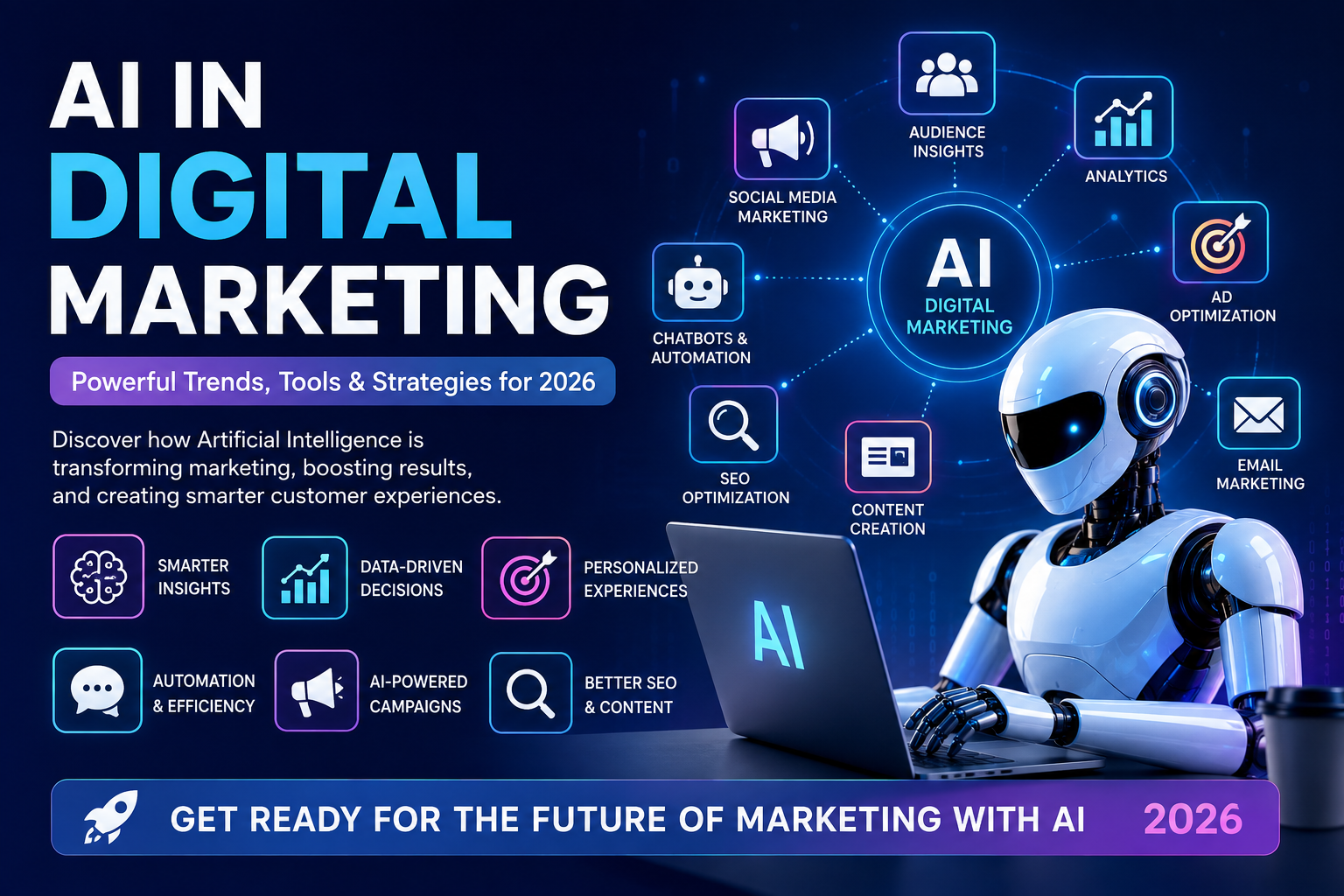
Digital marketing is changing quickly, and artificial intelligence is becoming one of the biggest reasons behind this change. AI in Digital Marketing helps businesses understand customers, create content, analyze data, improve advertisements, and automate repetitive tasks.
Earlier, digital marketers had to spend hours researching keywords, writing content, checking campaign data, and creating reports. However, AI tools can now complete many of these tasks much faster.
But does AI replace digital marketers?
Not completely. AI works best when marketers combine technology with creativity, strategy, and human understanding. Therefore, learning how to use AI has become an important skill for modern marketers.
In this blog, we will explore the latest AI trends, useful tools, practical strategies, and the Benefits of AI in digital marketing for businesses and marketers in 2026.
Summary
AI in Digital Marketing means using artificial intelligence to improve different marketing activities.
Some important uses include:
- Content creation and optimization
- Search engine optimization
- Social media marketing
- Paid advertising
- Customer personalization
- Data analysis
- Email marketing
- Chatbots and customer support
- Marketing automation
- Predictive analytics
The Benefits of AI in digital marketing include saving time, improving productivity, understanding customer behavior, and making better data-based decisions.
However, marketers should not depend completely on AI. Human creativity, fact-checking, strategy, and emotional understanding are still important.
Main Content
What Is AI in Digital Marketing?
AI in Digital Marketing refers to using artificial intelligence technologies to plan, create, analyze, and improve marketing activities.
AI systems can process large amounts of information and identify patterns. Marketers can use these insights to understand what customers want and how they behave online.
For example, an AI tool can analyze customer searches and suggest topics that people may be interested in. A marketer can then use these suggestions to create useful blog posts, videos, social media content, or advertisements.
AI can also analyze previous campaign data and identify which advertisements perform better.
Therefore, AI does not simply make marketing faster. It can also help marketers make smarter decisions.
How AI Is Changing Digital Marketing in 2026
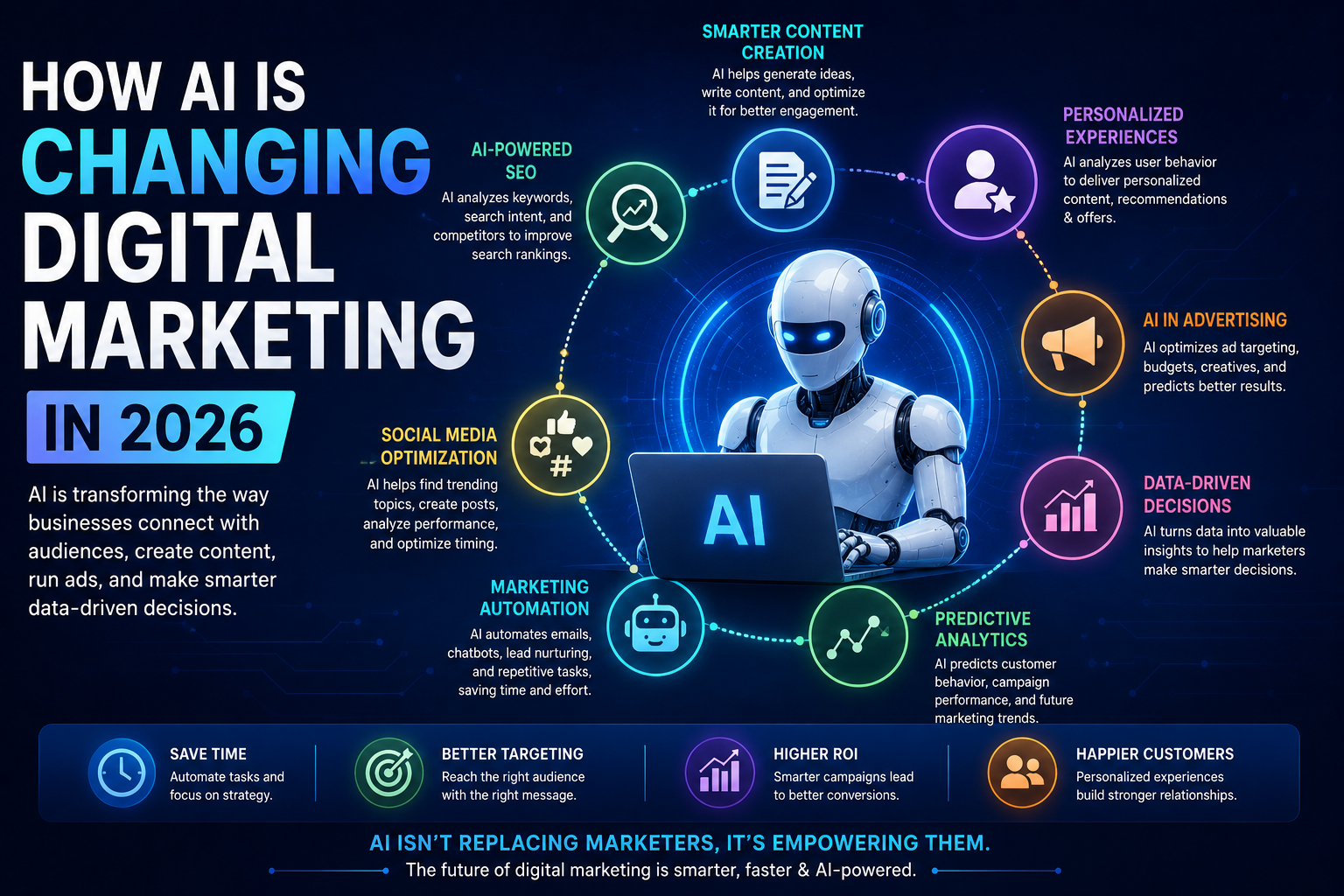
AI is influencing almost every major area of digital marketing.
1. AI-Powered Content Creation
Content remains an important part of digital marketing. However, creating ideas, outlines, captions, product descriptions, and email drafts can take considerable time.
AI writing tools can help marketers generate initial ideas and drafts quickly.
For example, marketers can use AI to:
- Generate blog ideas
- Create content outlines
- Write social media captions
- Create email drafts
- Generate product descriptions
- Improve headlines
- Repurpose existing content
However, marketers should always review AI-generated content before publishing it. Human editing helps improve accuracy, originality, tone, and usefulness.
2. AI and SEO
SEO is another area where AI is becoming increasingly useful.
AI can help marketers analyze search queries, identify content opportunities, understand search intent, and organize large amounts of keyword data.
For example, an SEO professional can use AI to find related topics around a primary keyword. The marketer can then create content that answers different questions users have about the topic.
AI can also help with:
- Keyword research
- Search intent analysis
- Content ideas
- Competitor research
- Content optimization
- Internal linking suggestions
- SEO reporting
However, marketers should not publish AI-generated content simply to increase the number of pages. Quality and search intent should remain the priority.
3. AI in Social Media Marketing
Social media marketers have to create content regularly. AI can make this process easier.
AI tools can suggest post ideas, captions, hashtags, content calendars, and creative concepts.
For example, a business selling clothing can use AI to generate different Instagram content ideas for product launches, festivals, offers, and customer engagement.
AI can also help analyze social media performance. Marketers can identify which posts receive more engagement and use those insights to improve future content.
Therefore, AI can help marketers spend less time on repetitive work and more time developing creative campaigns.
4. AI-Powered Advertising
Paid advertising generates a large amount of data.
AI can analyze this data and help marketers understand which campaigns, audiences, keywords, and advertisements are performing well.
AI can assist with:
- Audience analysis
- Ad copy ideas
- Campaign optimization
- Budget analysis
- Performance prediction
- Conversion analysis
For example, an advertising campaign may generate thousands of impressions and clicks. AI can help identify patterns in this data so marketers can make faster decisions.
However, marketers should still monitor campaigns carefully because automated recommendations may not always match the business goal.
5. Personalized Customer Experiences
Customers do not always want generic messages.
They expect brands to understand their interests and provide relevant information.
AI can analyze customer behavior, previous purchases, website activity, and interactions to help businesses create personalized experiences.
For example, an e-commerce website can recommend products based on a customer’s previous searches or purchases.
Similarly, an email marketing system can send different messages to different customer groups.
This personalization can make marketing communication more relevant and useful.
Benefits of AI in Digital Marketing
The Benefits of AI in digital marketing are not limited to automation. AI can support marketers in several important ways.
Saves Time
AI can automate repetitive tasks such as basic data analysis, content ideas, reporting, and customer responses.
Improves Productivity
Marketers can complete certain tasks faster and use their time for strategy and creativity.
Helps Understand Customers
AI can analyze large amounts of customer data and identify useful patterns.
Supports Better Decisions
AI can provide data-based insights that help marketers understand campaign performance.
Improves Personalization
Businesses can use customer information to provide more relevant content, offers, and recommendations.
Supports Marketing Automation
AI can help businesses automate parts of email marketing, customer support, advertising, and content workflows.
However, these benefits depend on how marketers use the technology. Good data, clear goals, and human supervision remain important.
Powerful AI Tools for Digital Marketing
Several types of AI tools can support modern marketing teams.
AI Writing Tools
These tools can help with content ideas, outlines, drafts, headlines, and editing.
AI SEO Tools
SEO-focused AI tools can assist with keyword research, content optimization, competitor analysis, and search intent.
AI Design Tools
AI-powered design platforms can help marketers create social media graphics, advertisements, presentations, and other visual content.
AI Analytics Tools
Analytics tools can help marketers understand website traffic, customer behavior, conversions, and campaign performance.
AI Chatbots
AI chatbots can answer common customer questions and provide support at any time.
The right tool depends on the business objective. Therefore, marketers should choose tools based on their actual needs instead of using AI simply because it is trending.
AI Marketing Strategies for 2026
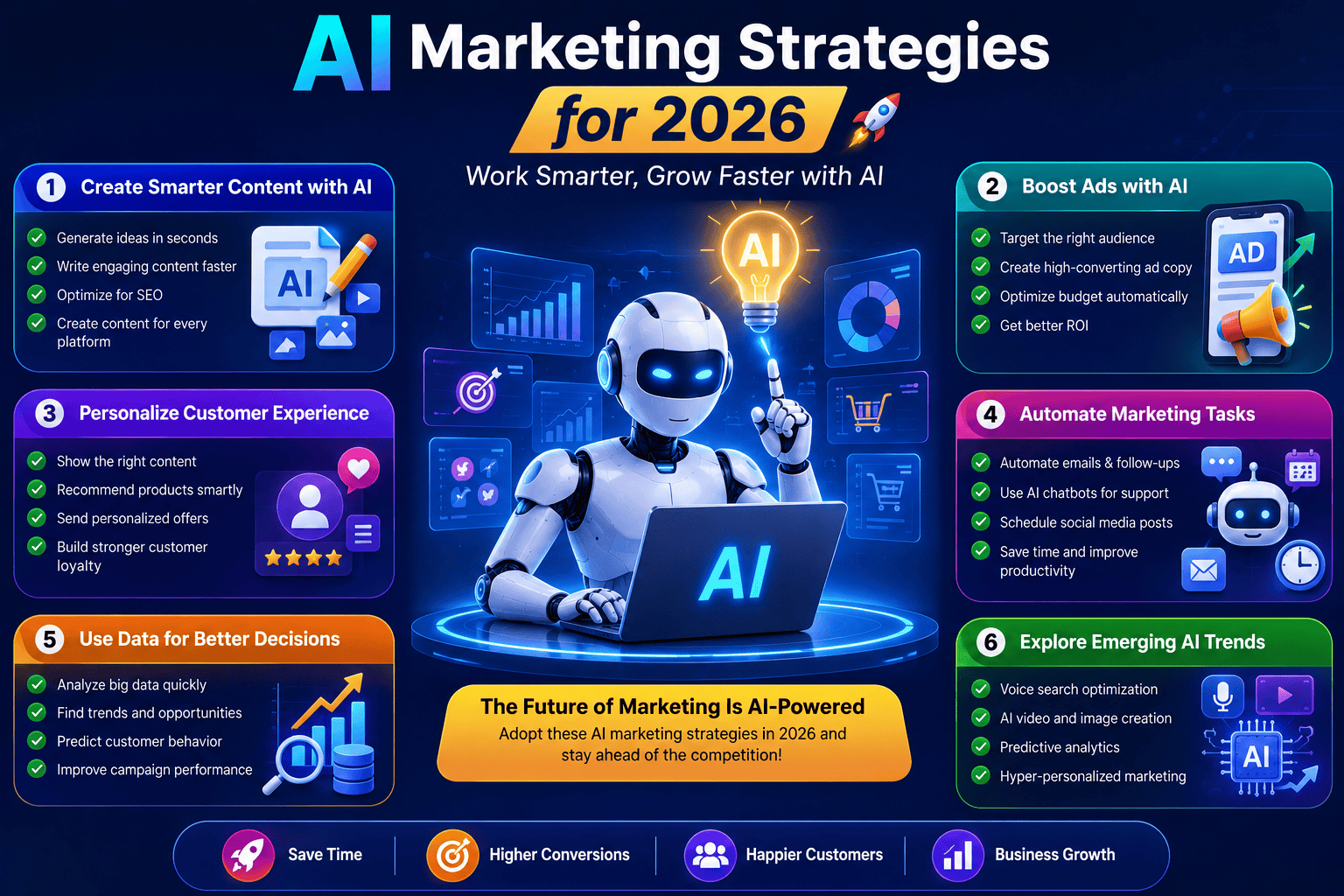
Businesses can use several practical strategies to make better use of AI.
Start With a Clear Goal
Before using an AI tool, decide what you want to achieve.
For example, your goal could be increasing website traffic, generating leads, improving engagement, or saving time.
Combine AI With Human Creativity
AI can generate ideas, but humans can add brand personality, experience, emotions, and originality.
Use AI for Data Analysis
Instead of manually studying large datasets, marketers can use AI to identify patterns and opportunities.
Personalize Customer Communication
Use customer information responsibly to create more relevant messages and experiences.
Check AI-Generated Information
AI can sometimes produce incorrect or outdated information. Therefore, marketers should verify important facts before publishing content.
Challenges of AI in Digital Marketing
AI offers many advantages, but it also creates challenges.
One major concern is incorrect information. AI tools can sometimes provide inaccurate answers.
Another challenge is overdependence. If marketers allow AI to make every decision, campaigns may lose their human personality.
Privacy is another important issue. Businesses must handle customer information responsibly and follow applicable privacy requirements.
There is also increasing competition because more businesses can create content and advertisements using AI.
Therefore, simply using AI is not enough. Marketers need a strong strategy to stand out.
Future of AI in Digital Marketing
The future of AI in Digital Marketing will likely focus on greater automation, personalization, predictive analysis, and integration across marketing platforms.
AI may help marketers predict customer needs before customers actively search for products. It may also make marketing campaigns more personalized and responsive.
However, human marketers will continue to play an important role.
Creativity, storytelling, strategic thinking, brand understanding, and emotional connection cannot be replaced simply by automation.
The strongest marketing teams will likely be those that combine AI technology with human creativity.
Conclusion
AI in Digital Marketing is changing how businesses create content, analyze data, communicate with customers, optimize SEO, and run advertising campaigns.
The technology can save time and improve productivity. More importantly, the Benefits of AI in digital marketing can help businesses understand customers and make better decisions.
However, AI should be treated as a powerful assistant rather than a complete replacement for marketers.
Businesses that learn to combine AI tools with human creativity, strategy, and responsible decision-making can build stronger marketing campaigns in 2026.
Learn Digital Marketing With Vidya Sarthi
Want to build practical digital marketing skills?
Vidya Sarthi Institute of Digital Education can help you learn important digital skills such as AI, SEO, social media marketing, content writing, Google Ads, and other digital marketing skills.
You can learn these skills in an easy and practical way and understand how modern marketing tools work.
Don’t wait for the future to arrive. Start learning today and prepare yourself for the growing digital career opportunities of tomorrow.
👉 Join Vidya Sarthi Institute of Digital Education and start building your digital future today!